
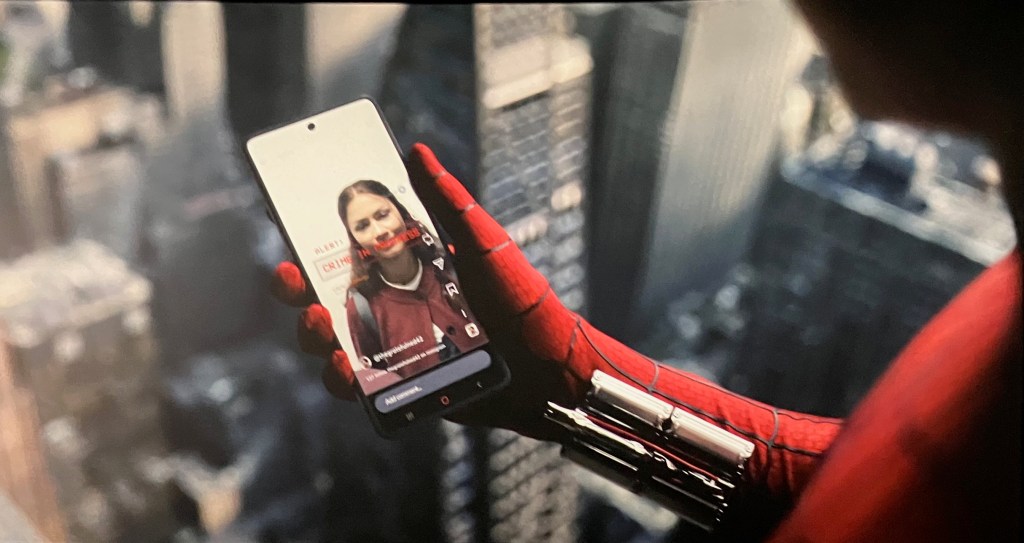
Last weekend SPIDER-MAN: BRAND NEW DAY became the first domestic film in history to hit $950M dollars. To make that kind of money, a film just doesn’t have to get audiences in the door, but they also have to get them back again and when they do come back, they usually also convince first-timers to see it with them.
Any domestic record breaking film has a variety of things that might resonate with an audience. convincing others to see it. The top 10 films at the domestic box office are BND, FORCE AWAKENS, ENDGAME, NO WAY HOME, AVATAR, TOP GUN: MAVERICK, BLACK PANTHER, AVATAR: WAY OF WATER, INFINITY WAR, and TITANIC.
Movies like these have to penetrate the psyche, especially if they are not a culmination to some grand serialized adventure like the AVENGERS were to the MCU. And while SPIDER-MAN is arguably a part of that adventure – it is not a culmination of it – and I would say its connections are also limited due to it being distributed by Sony Pictures. Peter Parker/Spider-Man’s participation is really limited to just his own films and AVENGERS films. BRAND NEW DAY is also being released five years after the most recent SPIDER-MAN film, NO WAY HOME, and takes place nearly five years after the vents of NO WAY HOME as well.
And while it does have a certain cache from its previous entries and magnetic cast, there’s still something to be said for grossing almost a billion dollars from just tickets alone. I’ve heard some grumpy haters recently argue that the film just builds off the MCU and sets up future films. And while it does do that with one character in particular, I would say that it is way more about Peter’s own struggles and that even that other character, Jean Grey, helps to elucidate Peter’s struggles through her own story. So what were the themes and stories that really helped make this a little more than your average Marvel film and make it resonate with viewers who wanted to see it again and again?
LONELINESS
This has been the most discussed theme of the film with Sony Chairman Tom Rothman even mentioning it in the interview. And while some have called it a “male loneliness” film, I think loneliness is pretty generalized, and when you add in Jean Grey – I’d say the film is just about being lonely and the pain that isolation can cause.
In the case of Peter Parker/Spider-Man that isolation means that he has become completely focused on his role as Spider-Man. For better or worse Peter Parker does not exist. I recently went to a WGA talk with Chris McKenna and Erik Sommers (the writers of BRAND NEW DAY) who explained that their favorite Spider-Man film is Sam Raimi’s SPIDER-MAN 2. They were intrigued by Raimi’s interpretation of the comics’ “Spider-Man No More” story and yet they knew they could not repeat it. So instead they flipped the concept and in their words told the story of “Peter Parker No More”.
In BRAND NEW DAY, Peter Parker is lonely, not just because he no longer has MJ or Ned, but because he doesn’t even have Peter Parker. His erasure has proven to be far more difficult than just erasing his connection to MJ and Ned. It has created a seismic ripple that has reduced the presence and belief in the need for a “Peter Parker” even in his own brain.
I’ve noticed some other critics say that Peter Parker doesn’t have a job. I’ve heard them complain that he does not go to college. But I think that is a VERY specific narrative choice to help push the idea of his loneliness further to the forefront of the film. If he had a job or a college he would inevitably have other friends and other co-workers. But because he choses to live inward (something that a lot of people do – sometimes myself included), he cuts those opportunities off, at first willingly, then almost subconsciously.

This decision to abandon Peter Parker is not something that manifests only socially either. In the film, it has grown to have a true physical representation. When he meets Yelena, Frank Castle, and Metzger, he never takes off his mask. When he introduces himself to MJ and Ned – he does not use the name Peter Parker, nor does he use it when speaking with Banner. There is absolutely no in-universe reason for this, other than he is a person who has essentially lost himself, or the ability to see Peter Parker’s value in this world.
And so it is that when Jean Grey finally discovers his identity, it is a shock to his system. When she says the name “Peter Parker”, it startles him – no one has said that name in so long. It’s not necessarily even fear that she knows his identity, that’s irrelevant. It’s a shock to him that she would think that a secret identity even exists. That she uses it to manipulate his deepest fears about people that he has already forgotten is an especially harsh move. But a lot of that is stoked by Jean’s loneliness and her desire to make someone pay.
We find out deep in the third act of the film that Jean has basically been living by herself, a hermit with a vengeance. She acts with a deep desire to find the one person that she had in her life – her sister Sara Grey – even if that desire sometimes means harming or tormenting people. But more importantly to the theme of loneliness, much as Peter only lives as Spider-Man, Jean only lives AS OTHER PEOPLE. She is anyone BUT Jean. And ironically the only person that she can’t be is Peter Parker.
In the end, forsaking yourself is the road to ultimate isolation. Often times we think, when we are lonely, that others do not want to be around us. But sadly, most of the time we don’t want to be around ourselves – the ultimate shame. And it’s kind of incredible that the theme is front and center in a massive comic book movie.
CONNECTION
Arguably, the inverse of loneliness is connection. And again, I think it speaks to the subversive qualities of this film that connection between a hero and a villain is ultimately what snaps them out of their respective isolation. Peter Parker knows no one. Jean Grey knows no one. But by the end of the film, they know each other and they have each other.
Peter makes an attempt to connect with MJ throughout the film, saving her, hiding her, but is ultimately rug-pulled BY her when she discovers the letter that he wrote to her over four years ago after the spell at the end of NO WAY HOME caused everyone to forget about Peter Parker.
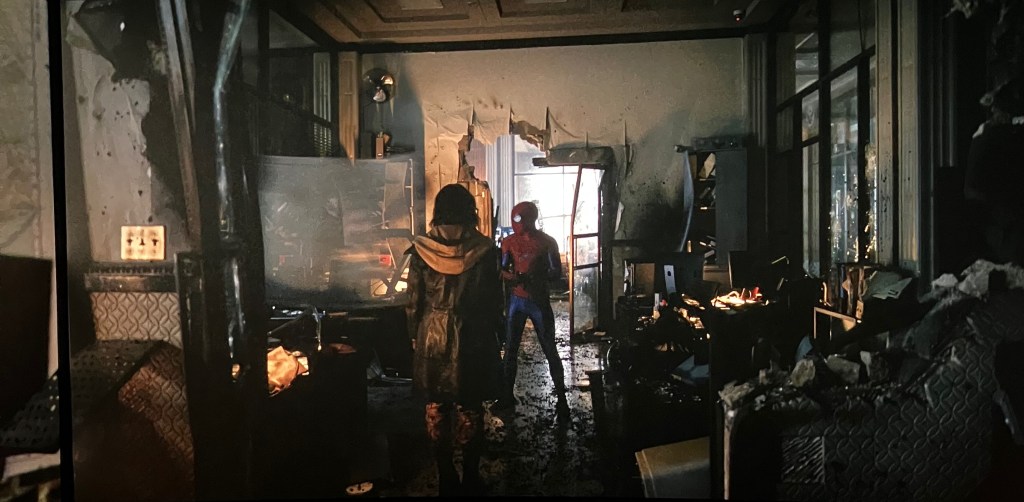
When MJ finds this, she does not suddenly remember Peter and rush into his arms. She almost coldly tells him that she does not love him because she does not KNOW him. It is a harsh reality for Peter Parker. And luckily by this time in the film, she does know him enough to trust him, invite her into her home and introduce him to Ned, Peter’s former best friend who has also since forgotten him due to that pesky spell. It is a nice moment to see the roots of this long withering plant begin to grow again, but it also appears that it will be a long time before we see a flower bloom between Peter and MJ.
But Jean Grey knows Peter – and she knows him inside and out. By the end of the film, Peter lets Jean enter his consciousness, meet Aunt May, and realize that being a super hero, someone with extraordinary powers, is a tough life – one filled with loneliness and isolation – but there will be people that love you and people that are there for you. And Peter makes the commitment to be one of those people for Jean. By stepping forward and connecting Peter also makes the ultimate sacrifice, taking a bullet for her and almost dying, but Jean’s connection with Peter allows her to keep him alive until he recovers.
The two are now connected mentally, physically, and emotionally – and it is that connection that defines this second theme and gives the audience the anecdote to that first theme of loneliness. Peter Parker never quite gets a real reunion with MJ – at least not one that leads to the two walking off into the sunset together. And we have to wait till the final frame of the film to see him connect with Ned.
Instead, the defining connection of the film is one between Peter Parker and Jean Grey. Through Jean’s intervention, Peter Parker doesn’t just realize that he needs to be Spider-Man, he realizes he needs to be Peter Parker too.
DUTY
BRAND NEW DAY uses duty as so many things – both adhering to it and abandoning it, which is why I am discussing it last. Also the value of duty is woven into the fabric of Spider-Man’s existence with Uncle Ben’s iconic quote, “with great power comes great responsibility.” So how does the concept of “Duty” factor into BRAND NEW DAY?
For Jean Grey, she has abandoned any semblance of using her powers for an altruistic or societal good. Instead she is using them to right a wrong, to find her sister who was kidnapped by Damage Control. What that means is that anyone who gets in her way can be possessed by her and potentially killed by her – bystanders, even a cleaning crew are turned into puppets so that she can get her way.

It is only after finally connecting (see theme above) with Peter Parker and looking into his own consciousness and memories, that Jean realizes her powers can be used for more – and for good. She turns on a dime after discovering this and when Peter sacrifices his life for hers, she realizes that she has a duty to keep him alive, to keep him breathing until he can survive on his own.
For Peter Parker, the concept of duty is even more complicated. While Peter is using a call to duty as Spider-Man to do good things for the city, he is also using his “duty” as a way to turn his back on the more painful aspects of his life – specifically anything personal and anything that has to do with a now non-existent Peter Parker. He has been doing just this for over four years by the time the audience catches up with him at the beginning of BRAND NEW DAY.
But Jean Grey, by acting as a very complicated antagonist that ultimately makes Peter question who he is fighting for and why he is doing it – snaps him out of it and challenges his concept of duty, pushing him to realize that there is more to him that just Spider-Man, there’s also Peter Parker.
Ultimately, SPIDER-MAN BRAND NEW DAY asks us to look at some very big picture themes that are connecting with audiences. People are lonely, people are looking for connection. And much like Peter and Jean, sometimes we all need to slow down and think about what we are doing – addressing the concept of duty.
I think it is these big picture themes that really get into the mind of the audience and make them revisit the film again and again. These are all themes that are at the top of the public conscious in 2026 – and once you think about that maybe the box office numbers aren’t quite as surprising as they once were.