Did He Set Up The“Ending” – FIGHT CLUB style? Maybe. Take a read in this month’s installment of “Just A Theory”…
I remain uniquely fascinated by JOKER: FOLIE A DEUX, the sequel to Todd Phillps’ JOKER, the 2019 billion dollar Oscar winning mega-hit starring Joaquin Phoenix. I am uniquely captivated by both the actual film and the public and critical reaction to it. And over the past few weeks, I’ve had a chance to think about JOKER: FOLIE A DEUX (aka JOKER 2) a bit more after first outlining my take on the themes and directorial intent of the film. The film remains a fascinating exploration of a multitude of both implicit and explicit themes. The film continues to be an intriguing exploration of numerous subtle and overt themes. Was there something we missed as a collective audience? Was there intent we misinterpreted? Those are questions I attempted to answer in my first piece. But one of those themes only recently became visible to me after a third (yes that’s right) viewing of the film.
My first watch was on opening weekend, the second time was in dual laser digital IMAX last week, and finally in IMAX 70MM film yesterday. Watching JOKER 2, three different times in three different formats, has, admittedly, allowed my mind to come to some difficult if intriguing conclusions that there might be something bigger going on here.After viewing the movie JOKER 2 three times in distinct formats, I have arrived at some thought-provoking and difficult conclusions that suggest deeper meanings within the narrative.
Is there a possibility that Joker was actually behind almost all of the machinations of the plot? Is there a possibility that the brutal finale and courthouse bombing was Joker’s idea all along? And that even the ending, Arthur’s end – and spoilers here if you have not seen the film – at the hand of a “new”Joker – might have been Joker’s intent and possibly even a way that Arthur would “see” Joker killing Arthur?
I definitely think there is an argument for it – and I think it is pretty strong.
One of the main threads of JOKER 2’s explicit plot revolves around determining whether or not Joker and Athur are the same “person” or in fact if Joker/Arthur is a victim of dissociative personality disorder or “split personalities” and that the “Arthur Fleck” personality might be separate from the “Joker” personality. This would then further Arthur’s defense lawyer’s argument that the six deaths in the first film were attributable to “Joker” and not “Arthur”.
This idea is pursued both through an in-universe legal trial – as well as in Arthur’s own self-actualization as Arthur attempts to wrestle between the “Joker” personality and the “Arthur” personality as he navigates a budding romance with Harleen Quinzel aka Lee Quinzel aka Harley Quinn (played by Lady Gaga). Within the film, ultimately Arthur takes responsibility for the Joker, first in a way to empower him with “The Joker Is Me” song, and then after his long night at Arkham where he is abused by the guards, as a way to admit culpability and responsibility and demonstrate guilt for the murders in front of the jury. Arthur comes to the mental conclusion that there is no iconic violent Joker separated from sweet Arthur – rather they are one in the same and can exist in nearly the same moment.
But are they?
After watching the film multiple times, I think there are more than enough clues to point that something else might be going on. It is not easy, it is not clear, and it is not definitive. But I believe that is director Todd Phillips’ intent.
My theory is that Joker is in fact a separate personality intent on subverting and killing Arthur, making Arthur take the blame for the six murders of the first film, and ultimately murdering Arthur to unleash the real and true Joker in the film’s explosive and brutal finale. This process is enabled and assisted by Harley as she continuously acts to keep this quest on mission for the Joker personality to subvert and conquer the Arthur personality.
It is not readily apparent that there is a, let’s just call it for the sake of shorthand, a FIGHT CLUB situation going on in this film. In the movie FIGHT CLUB, the protagonist struggles with dissociative personality disorder, resulting in split personalities, each with distinct actions and thoughts. One side of the personality, known as the narrator, plays the innocent in the film, while the other side, Tyler Durden, plays the instigator and eventual antagonist to the narrator.
This merging of identities remains concealed from the audience for most of the film. The film employs two distinct characters to portray this split personality, which is only revealed in the final act. It is then discovered that Tyler Durden and the narrator are actually the same individual, a creation of the narrator as a means of expression and action. Tyler memorably reveals this in Act 3, stating, “You wanted a way to change your life,” while pointing to himself, revealing that he and the narrator are one and the same.
Could something similar be occurring in this film? Could Joker be acting without Arthur’s own knowledge, much in the way Tyler Durden acted with the narrator’s knowledge in FIGHT CLUB? Many audience members and critics were quick to point out that the “Folie A Deux” of the title is a reference to Harley and Joker’s relationship. Folie à deux (French for ‘madness of two’), also called shared psychosis or shared delusional disorder (SDD), is a psychiatric syndrome in which symptoms of a delusional belief are “transmitted” from one individual to another. But what if this title and its associated disorder was actually referring to Joker and Arthur’s relationship? Arthur and Joker are two separate personalities sharing a body and acting independently of each other. This character’s existence, hereinafter referred to as Joker/Arthur for purposes of the essay, is at first a subtle possibility in the film but by the third act is an obvious, if not explicit reality.
EVIDENCE OF SOMETHING ELSE GOING ON IN JOKER 2

Towards the beginning of JOKER 2, as the audience is introduced to Joker/Arthur and his new life inside of E-Block of Arkham, we get a callback to the original JOKER (2019) film as THAT’S LIFE by Frank Sinatra is played over a montage of the day’s activities. Jackie Sullivan, the sadistic Arkham guard played by Brendan Gleeson, has just informed Joker/Arthur that he has received permission for Joker/Arthur to attend choir class in B Block (an area of Arkham reserved for less violent inmates that affords them more freedom and less restriction of movement).
Joker/Arthur is thrilled. Earlier that day, Joker/Arthur made eye contact with Harley when walking through the B-Block hall on the way to meet with this defense attorney earlier in the film and is clearly excited by the prospect of a reunion. This chance to participate in the choir is at first played humorously and innocently, in the way that Arthur personality might interpret the courtship – and as Arthur personality continues to approach the relationship throughout the film. As the montage concludes and Joker/Arthur is locked up in his cell, THAT’S LIFE wraps up and we fade out on Joker/Arthur lighting up a cigarette (that he has presumably smuggled into his cell) to a large grin. I believe this is the first time and one of the only times that we explicitly see the Joker personality prior to the third act.
Joker/Arthur have their official “meet cute” and seem to instantly fall in love – though each personality falls in love for different reasons. In my scenario, the Joker personality is looking for someone who will aid him in breaking out of Arkham and killing the Arthur personality, stroking his ego while easing him out of this current hellish existence. While the Arthur personality is looking for someone who will humanize him and see him as something more than just a brutal killer. Unfortunately for Arthur, and the key to Joker personality’s plan, is that to do that and to gain that affection, Arthur must wear the Joker mask- a dangerous step that will ultimately lead to Arthur’s demise at the hands of the Joker personality.
Musical Numbers As A Way To “Cover Up” The Actions of Joker
Anyway, Joker/Arthur and Harley fall madly in love over a set of musical numbers, some presented as being real – or at least interpretations of action that were set in reality – and in fantasy. The musical numbers superficially act as an analog or replacement to the action set pieces that are the usual fodder of comic book films. In other words, the musical numbers become the character’s and audience’s emotional bridge to more plot-oriented scenes (although some audiences have felt them less interesting than others) while also mirroring the character’s changing mental states.

But the musical numbers could arguably operate as a way for Joker to mask his actions from Arthur. After all, the audience does not know what is really going on between Harley and Arthur in “hard reality” during these musical numbers. The musical numbers are presented as a stylized view of this so-called “hard reality”, complete with orchestra and choreography, often in time with violence – both real and imagined.
In FIGHT CLUB, Tyler and the Narrator split their shared body through the use of sleep as oftentimes the Narrator fell asleep for hours while Tyler went out and did things at night. Here in JOKER 2, the musical numbers are arguably operating as a similar device for personality transference. Think of it this way:
- “Bewitched, Bothered, and Bewildered”: Joker realizes that he is going to use Harley to get out of Arkham.
- “That’s Entertainment”: Joker explains to Harley that he needs her help to escape from Arkham.
- “Close To You”: Harley tells Joker that he needs to stay on-mission and that Arthur’s concerns about the nature of her intent is irrelevant in his ultimate plan. Joker tells Harley to continue to stoke public support for Joker.
- “Gonna Build A Mountain”: Joker convinces Harley to plant the courthouse bomb.
- “If You Go Away”: Joker leaves a message for Harley to detonate the bomb.
While these are not confirmed, they are also not implausible. All could definitely be a way Joker could have planned the ultimate third act of destruction.
Harley’s relationship with Joker/Arthur is also noticeably similar to that of Marla Singer with Tyler/the Narrator in FIGHT CLUB. She is the only person who could ultimately reveal to the Narrator and confirm that he and Tyler are one in the same. The opposite is true of Joker/Arthur as the Marla-esque character of Harley Quinn becomes the one person who can definitively hide these personalities from each other.
Logic And Time Gaps In The Plot
It is telling that when Harley shows up in Joker/Arthur’s jail cell, he is confused and asks, “is this really you” seemingly hinting that Joker/Arthur is having difficulty parsing his multiple realities from his multiple fantasies. And I think Harley is instrumental in keeping Joker “on mission” throughout the film, and especially in the film’s climax, when Arthur’s doubts creep in again. She is presumably helping his cause outside as well, giving interviews and stoking the public into supporting Joker which enables the Joker side of his personality to grow through narcissistic love, undermining Arthur’s seemingly good-natured lawyer, and likely setting up his ultimate escape at the courthouse..
There are also gaps in the film’s internal plot logic that seem to further hint at this dissociative personality disorder. Some of these gaps are below:
- Why would the prison system let Joker/Arthur join a choir at the behest of brutal prison guard Jackie Sullivan?
- How exactly do Joker/Arthur and Harley escape during and after the screening of “The Band Wagon” and not get seriously injured or shot while singing and dancing?
- How does Harley show up in Joker/Arthur’s jail cell?
- Harley’s seeming confusion at Arthur’s questioning in the visitor booths at Arkham when Joker/Arthur questions her on her true intentions of their courtship.
- What actually happens to Joker/Arthur with Jackie Sullivan and his pals in the prison showers (a point which I had major issues with but later have come to believe might be a way to demonstrate Joker/Arthur’s dissociative personality disorder)?
- How does Joker/Arthur get from the courthouse to the steps of his old apartment seemingly undetected?
Harvey Dent’s Statement In Voiceover
And the final bit of evidence that something else is going on is DA Harvey Dent’s belief that everything that has happened at the trial is all part of Joker’s plan. In a voiceover that begins at the end of the second act and the beginning of the third, just before Joker/Arthur gives himself over to the Joker personality at the trial, we hear Harvey in an interview doubt that Joker/Arthur is acting insanely in his desire to represent himself as Joker at trial. Harvey says, “This is all a part of Joker’s (note he does not say Arthur) plan and exactly what he wants.” When I first saw the film, I thought this was an indication of Dent’s general lack of empathy – and it arguably still is – but now I have come to believe that it is also a true and valid statement.

And it is of the utmost importance that Harvey Dent is the person who says it. This is because Harvey will eventually become a villain in this universe of Gotham City/BATMAN, presumably transforming into Two-Face (the physicality of which happens due to the courthouse bombing), thereby indicating that he has those seeds of a villain inside of him now (something readily apparent in the film). Why is that important? Because (and this has always been true of the Batman comics) in a way, “it takes one to know one.” Moreover, Harvey Dent has always been great at predicting how both Batman AND other villains will act through their motivations.
SO, WHAT WAS “THE PLAN”?
Joker and Harley aimed to resurrect Joker from his broken state as Arthur and restore him to the criminal mastermind he was in the first film. This plan was supposedly outlined by Joker and Harley themselves and was partially deconstructed into plot steps in the prior subsection that analyzed musical numbers.This would be a long process where Harley would essentially have to address both Joker AND Arthur. And the success of this plan would ultimately mean that Joker would have to kill Arthur – something that happens in plain sight in the film. But this murder could actually be a more symbolic murder if we follow my theory all the way through.
Hear me out.
At the Arkham visitation booth about halfway through the film, Harley reveals to Joker/Arthur that she is pregnant (among other things). This reveal lands on the Arthur personality that is actively questioning Harley and her intentions in this scene, and sends him back towards Harley and his fate as the Joker. Harley symbolically uses her make-up to draw a smile on the visitation booth glass that Joker/Arthur then lines up with – signaling that their plan is back “on”.
But what is the pregnancy representative of? Surely Harley is lying at this moment, at least in a sense that she is truly pregnant. Rather, the idea would be that Arthur would symbolically impregnate Harley with Joker – and that Harley would give birth to Joker. And that Joker would eventually kill Arthur. This oedipal cycle is embedded in the fabric of the film and it would take a lot of Harley and Joker’s manipulation to get rid of Arthur once and for all when Harley sets off the bomb at the courthouse, freeing Joker where he would symbolically kill Arthur by leaving him behind in the rubble. And Arthur proves to be a stronger fighter than either Joker or Harley expected, which leads to the ultimate ending of the film.
Is an explicit transformation of personality from Arthur to Joker through birth, death and rebirth a crazy idea? I think that if we look at the trio of characters that follow Joker around throughout the film as his “shadows”, we can further see this plan in motion. These characters actually provide a Rosetta stone for the personality phases and transitions that Joker/Arthur take on as the film progresses.
USING JOKER/ARTHUR’S “SHADOWS” AS A WAY TO READ THE FILM
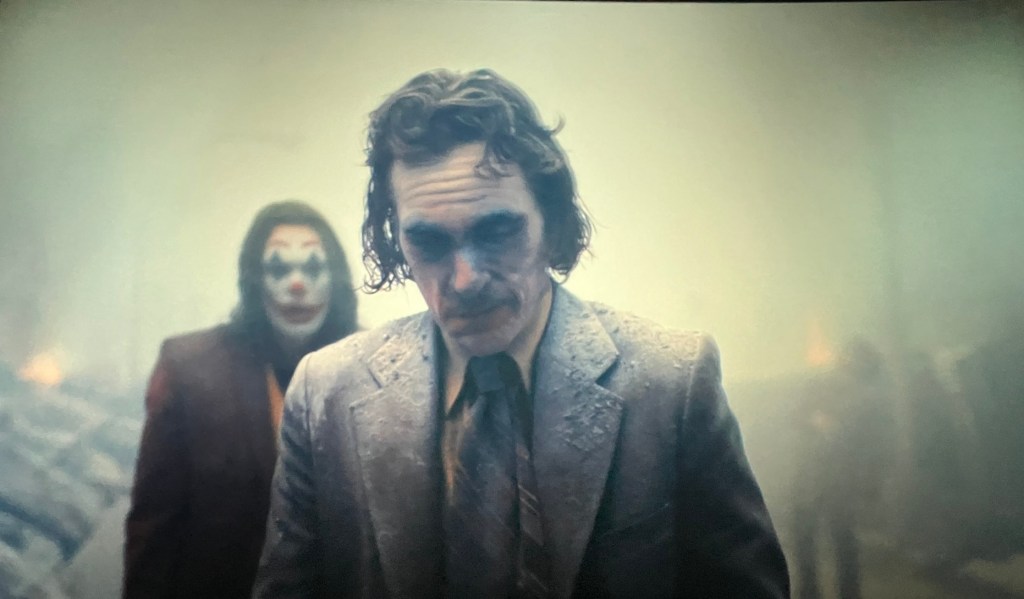
Joker has three “shadows” throughout the film, characters that follow him around and mimic, observe, help, and obstruct him. The shadows are also an indication of which personality is in the driver’s seat at various points in the film. The existence of these shadows (and the dissociative personality disorder) is further underlined by the opening cartoon in JOKER 2 which replays the events of the fateful Murray Franklin show from JOKER 2019 in the form of a “Looney Tunes” cartoon. Arthur’s shadow essentially becomes Joker and locks Arthur in the dressing room closet. By the time Arthur catches up, things have already gone out of control and it is too late for either Joker or Arthur to turn back.
The First Shadow
The first shadow is the noticeably named “Ricky Meline” (as in “a LINE that goes back to ME”), an inmate who idolizes Joker/Arthur and is played by Jacob Lofland. When Ricky is around this is a hint that the Arthur personality is in control. Ricky and Arthur share a kiss early on in the film and smoke cigarettes together, hinting at perhaps something more desired for the relationship between them.

Ricky follows Joker/Arthur around, oftentimes even wanting to go with him to his visitations and his cell. He mimics him when Joker/Arthur dances, echoes him when he sings “When The Saints Go Marching In” and noticeably speaks up for him after Joker/Arthur is abused by the guards. Ricky is then murdered by the guards, seemingly foreshadowing the eventual death of Arthur. Ricky’s end is essentially Arthur’s end as well – whether Arthur knows it or not… and ultimately Ricky is replaced by the second of Joker/Arthur’s shadows.
The Second Shadow
The second shadow appears in Act 3 after the bombing at the courthouse – and his appearance is essentially a clone of the Joker from the first film. He is listed as “Joker Doppelganger” and is played by Hunter Oz. His hair, costume, and make-up all mirror that 2019 Joker – a costume that Joker/Arthur fails to wear in this film (but for a fantasy musical interlude). The appearance of this 2019 lookalike is a hint that Joker personality is now in charge, or at least responsible for the courthouse bombing at this point.

This lookalike shadow delivers Joker/Arthur from the ground zero of the explosion to deeper into the city whereupon Joker/Arthur escapes to eventually return to his old apartment, where Harley is now staying. During the car ride where the 2019 lookalike shadow and his partner take Joker/Arthur from the site of the bombing, Billy Joel’s “My Life” is plays on the car radio – a potential coded message from the Joker personality to the Arthur personality with the following lyrics:
“I don’t need you to worry for me cause I’m alright/ I don’t want you to tell me it’s time to come home/ I don’t care what you say anymore, this is my life/ Go ahead with your own life and leave me alone. Keep it to yourself, it’s my life!”
In addition, when Arthur escapes from the car into oncoming traffic, it is visually similar to when the Narrator in David Fincher’s FIGHT CLUB, has realized that he and Tyler are one in the same and begins to actively undo his previous plans (something eerily similar to what the Arthur personality is trying to do at this point in the film).
Arthur finally arrives to find Harley at the steps of his old apartment. The second shadow has been left behind. The Arthur personality is firmly in control (as evidenced by his face and make-up washed away) and is also firmly rejected by Harley. The plan has seemingly gone awry. Harley has no desire to run away with Arthur. She leaves. And while some have argued this is the ultimate rejection of Arthur (and I agree with this), I also think Harley is leaving to shock Arthur back to Joker’s personality, and to lead him into a final form of Joker that is seen in the third and final shadow.
The Third Shadow
The third and final shadow is the very dangerous and deliberately unnamed convict that ultimately kills Arthur (note I did not say Joker/Arthur here) at the end of the film. This character is never acknowledged by other characters in the films or the guards – as Rickey Meline is numerous times and is never named in the screenplay or film.
This third shadow is arguably a physical manifestation for Arthur of the Joker personality. He is happy when Joker/Arthur is rebelling inside the prison, happy when Joker personality has fired his lawyer and taken over the trial, and pissed when the Arthur personality admits culpability for the crimes.
Played in a memorable near silent performance (ie a TRUE shadow) by Connor Storrie, this third shadow ultimately ends up killing Joker/Arthur, stabbing him with a shiv in the prison hallway on the way to a visitation (with whom is left purposefully unknown), and giving himself a Glasgow smile while Arthur writhes in pain and dies. Some have theorized that this inmate ultimately becomes Heath Ledger’s Joker in THE DARK KNIGHT but I think that is a bit too simplistic or broad of a read on the actions at play. Rather the “Glasgow smile” is meant to represent the invocation of a TRUE Joker, one that cannot escape when the make-up is washed off. Is this inmate the way that Arthur would visualize the Joker personality finally killing the Arthur personality? That is what I think.

This shadow presumably kills Arthur at the end of the film setting the stage for a resurrection of the true Joker personality. Whether this is a symbolic or actual death is really immaterial, as only a true Joker personality, or version of Joker is left at the end of the film. The Arthur personality is dead – arguably literally and figuratively. Moreover, I would reason that there is a way to read the ending as a way where this new Joker is actually just the Joker personality, now fully in charge, about to go meet Harley and presumably escape, this time showing up as Joker and not as Arthur.
WHY NO FIGHT CLUB REVEAL?
You may wonder, if this was the director’s intent, why does Todd Phillips obfuscate his point to this degree? At this point, FIGHT CLUB is 25 years old and I think a straight ahead reveal of the two personalities being confirmed would be both dated and simple simultaneously. Hiding the reveals and hints within the film, allows Phillips to give the audience more ways to interpret the film without it being a simplistic rendition of the FIGHT CLUB plot – and honestly much more closely mimics Joker/Arthur’s own plight with dissociative personality disorder during the film.
Furthermore, JOKER 2 is an inversion of the FIGHT CLUB plot in that we know both personalities exist from the onset. Confirming that the Joker personality has been subverting the Arthur personality would undermine the strength of the plot and be overly simplistic considering we already know both personalities exist from the onset of the film.
CONCLUSIONS
In conclusion, there is a real chance that the entire JOKER 2 film is a greater statement on dissociative personality disorder as channeled through Joker/Arthur’s journey – implicitly embedded within the plot of the film – both in terms of Harley Quinn’s actions, Harvey Dent’s statement, plot gaps, the musical numbers, those characters that shadow Joker/Arthur throughout, and the ultimate ending.In conclusion, the upcoming film JOKER 2 holds the potential to present a profound exploration of dissociative personality disorder through the lens of Joker/Arthur’s journey. This theme is subtly woven into the plot, revealing itself in various elements of the film.
Harley Quinn’s actions, for instance, may serve as a reflection of Joker/Arthur’s dissociative episodes. Her unpredictable and erratic behavior could parallel his own fragmented mental state. Additionally, Harvey Dent’s statement about the city’s declining mental health may hint at the prevalence of dissociative personality disorder among Gotham’s citizens.
Plot gaps and inconsistencies could further emphasize Joker/Arthur’s dissociative experiences, as they often leave viewers questioning the reality of events. The musical numbers, with their surreal and dreamlike quality, might represent Joker/Arthur’s subjective perceptions of his own life.
Furthermore, the presence of characters who shadow Joker/Arthur throughout the film could symbolize different aspects of his fragmented personality. For example, a character who consistently appears in the background, always watching Joker/Arthur, might represent his inner critic or conscience.
Ultimately, the ending of the film could provide a powerful commentary on dissociative personality disorder. Whether Joker/Arthur finds redemption or succumbs to his darker impulses, the conclusion may explore the complexities of living with this condition.
In essence, JOKER 2 has the opportunity to offer a nuanced and thought-provoking examination of dissociative personality disorder. By exploring this theme through Joker/Arthur’s journey, the film can shed light on the challenges and struggles faced by individuals with this condition.
But what do you think? Do you buy this theory at all? Do you have a theory of your own?
 No Scoops Club
Just watched the film and exactly what I thought, you’re absolutely on point. I thought it’s too easy an ending ,” it was all a joke or the jokes on us “, made no sense but I knew when he got stabbed , the disturbed laughter , the Glasgow kiss. It was Joker killing Arthur and taking over permanently, everytime Arthur got rejected laughed at Joker would come out. Theres no way you could have all that abuse as a child, kill your mother, 5 others , consider more and then at the end of the film say, “Im okay now , nothing wrong with me at all ??? “
Thankyou for the Fight Club reference, I knew I’d seen a film before years back similar theme, I thought it might have been ‘Split’ but it was Fight Club (also a great film).
LikeLiked by 1 person
Thanks for reading and the comment! That’s a great call on SPLIT – I had not thought about that, which has some similar elements also. Yeah, the whole surface level plot felt a bit too simple for me to accept. I think it’s a really interesting film and Phillips definitely layered much more into it than people initially gave it credit for. Thanks again!
LikeLike
Arthur Fleck is the Joker in disguise. He is the locked-up Joker alter-ego, like Clark Kent. Arthur Fleck Arkham Reflection.
LikeLike
I really like the movie and the pregnant scene is my favorite scene in the movie. I think further evidence to support your idea is the musical scene right after Arthur gets stabbed in which we still see evidence of the joker being alive even though the simple interpretation would suggest this part of Arthur is gone.
LikeLiked by 1 person
Thanks for reading! I really love that observation – and how it absolutely adds to the theory of Joker being there. 100%. Thank you!
LikeLike
This was great! I really love your interpretation/dissection/analysis/very possibly on the nose accurate understanding of the film! I have only seen it once but believe my mind was trying to parse out some of the things you included here. Now I absolutely can’t wait to watch it again with all of this mind and really have blast with it on every level. I had already very much enjoyed but am grateful that it goes deeper and for you putting this all down on ‘paper’ here. Great job!
LikeLike
Thanks Ben! I really appreciate the comment and your reading the blog. It was a really great movie with a lot going on. Thank you again!
LikeLike
Great video! Look at who or what is over Joker/Arthurs shoulder. If it is to the left it is Arthur and to the right is the Joker.
LikeLike