We’re only six episodes into SKELETON CREW and it has already become one of my favorite sci-fi TV series of the year and favorite STAR WARS series ever. The correct formula is there: it feels like 1980’s filmmaking and it FEELS like 1980’s era STAR WARS (an important distinction from being just recognizably in the STAR WARS universe). Moreover, SKELETON CREW does not just feel like STAR WARS – SKELETON CREW feels like the 1980s.
There have already been countless vlogs and essays on influences and easter eggs found in the series episodes so far. And the show pays direct homage to all kinds of 1980’s pop culture works and artifacts – from ET to THE GOONIES to THE BREAKFAST CLUB. No disrespect, but these are all very overt influences found on the top layer of analysis for both the story and characters that everyone would know – be you a Gen Xer or a Millenial or a Gen Zer.
But there are many other influences, some very obvious and some, perhaps, not so obvious. And one of the latter but arguably one of the most important influences, I would argue, is filmmaker Joe Pytka. Pytka created massively influential templates for both kids characters in the 1980s and sci-fi style and photography in the 1980s through his commercial work that was so ubiquitous that it went on to influence film and television of the era.
Moreover, Pytka was one of the most important artists in creating, refining, and ultimately and perfecting the world and style of 1980’s cinema and TV that is then on display in SKELETON CREW. Pytka’s is a name you might know as the director of the classic 1996 Michael Jordan vs Bugs Bunny basketball film, SPACE JAM. But Joe already had quite a career prior to that (he was almost 60 when he directed SPACE JAM) and was instrumental in creating the purposely lived-in, ultimately polished, and highly atmospheric look that so many have come to associate with the “me decade”, a look that is on full display in SKELETON CREW.
The late 70s and early 80s were a fascinating time for the emerging “art form” of the TV commercial. The period had directors like Ridley Scott, Alan Parker, Adrian Lyne, and Pytka creating a new visual language when it came to 30 and 60 second TV commercials. This was also a period when the general public’s eyes and attention were glued to network TV nightly – and commercials were ubiquitous and unavoidable.
VCR’s had not yet quite become an accepted or prevalent method to avoid commercials just yet. And “water cooler” TV was at the height of its powers. You wanted to watch TV ASAP so you could join in the conversation. And to do that, you had to watch the commercials too. So commercials in the 80’s were just as much of a part of the fabric of pop culture as the shows they parsed. This new class of TV commercial directors maximized the attention of their captive audience and transformed the way a generation would look at film and TV.
JOE PYTKA AND THE TRANSFORMATION OF THE TV COMMERCIAL
Joe Pytka was born in 1938 in Pittsburgh, Pennsylvania and studied film and TV at the school that would become Carnegie Mellon. He began his career making documentaries for Pittsburgh’s WQED including “A View From The Sky” on the 1967 World’s Fair. Pytka also directed the documentary “Maggie’s Farm”, which used Richie Havens and Bob Dylan’s music to create a nascent version of what would become the music video of the 1980s. Pytka also pursued varied interests including motorcycle racing and off-road racing, eventually producing documentaries about the subject. Pytka would move from Pittsburgh to Los Angeles and back to New York by the late 1970s, where he began to use his documentary styling and track record to get TV commercial work.
And it was at this time that documentary filmmaking was being used, albeit a stylistic version, as a way to reframe what could be done in the TV commercial space. So let’s start back toward the beginning of Pytka’s commercial directing career in the late 1970s and early 1980s. It was in these years that Pytka seemingly transformed the cinematography and mood of emerging 1970’s UK filmmakers like Adrian Lynne and Ridley Scott – who were using this stylized documentary style. Check out Ridley Scott’s commercial from 1977 for Guiness. This spot went on to win multiple awards for its visuals and approach to editing and ultimately, successful marketing.
Pytka refined this style and put it into more accessible situations for the general public or more specifically kids, swapping out Guinness beer with Hershey’s chocolate syrup and adding a narrative (an important step) that enhanced his late 70s and early 1980s work…
Pytka’s commercials also crossed the threshold from network prime time TV and into Saturday Morning TV. Where the impressionable minds of Gen Xers like Jon Watts (creator of SKELETON CREW) would sit and inhale their pop culture. His work in the late 1970s and early 1980s paved the way for children’s exposure to a more mature visual palette and science fiction. As a result, kids watching Saturday morning cartoons were introduced to a more sophisticated aesthetic through Pytka’s work, rather than just the typical animated cereal commercials and silly 1970s ads.
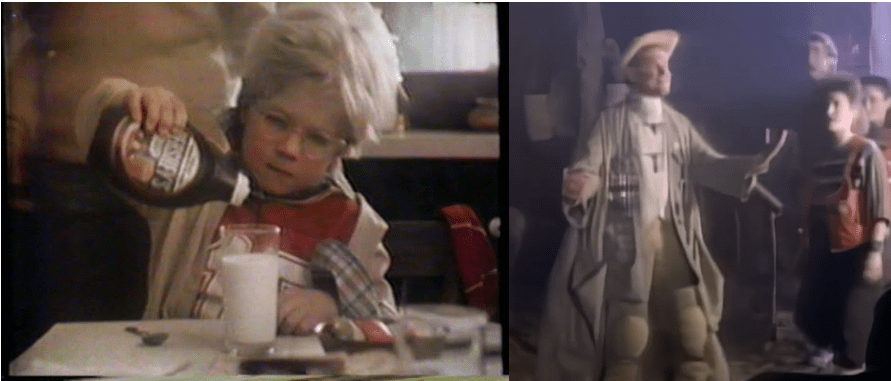
Two of Pytka’s most influential commercials in that precious Saturday morning kids space were his series of “Messy Marvin” commercials for Hershey’s chocolate syrup and the famous and ever-present “Archaeology” commercial for Pepsi Cola. The “Archaeology” commercial and the “Messy Marvin” series are also particularly important for SKELETON CREW. Each sets up important 80s stylistic and (arguably) narrative paradigms that SKELETON CREW mines.
“MESSY MARVIN” SERIES (1979 – 1985) FOR HERSHEY’S – DIRECTED BY JOE PYTKA
In the case of “Messy Marvin”, Pytka arguably births the iconic paradigm of THE 1980’s kid. That is an idiosyncratic oddball suburban kid who still manages to get the job done “his way”. The pop culture apotheosis of this profile would come 12 years later with Kevin McCallister in Chris Columbus’ HOME ALONE. But characters like Marvin were ever present in 1980’s cinema – from Elliott and his friends in ET to the gang in THE GOONIES. And the character of Messy Marvin and his 80’s progeny have an undeniable influence on the make-up of the SKELETON CREW gang from at Attin. The influence of Joe Pytka’s Messy Marvin was everywhere. And even if SKELETON CREW creator Jon Watts would not admit to knowing Messy Marvin, the movies that influenced him and SKELETON CREW were influenced by Messy Marvin.
A granular analysis of the plots of the series of eight commercials, deduces the usual narrative arc of Marvin in each installment of the series. Marvin was a notoriously messy kid tasked with everyday mundane suburban kid chores; think cleaning up his room, painting his tree house, organizing the garage. And each time he is tasked with said chore, Marvin is quite unable to complete it, at least initially. But then after drinking a glass of milk (made with Hershey’s chocolate syrup, of course), Marvin is able to complete the assigned task, albeit not in the way that you might not necessarily imagine.
Pytka’s Messy Marvin was often pitched by the commercial narrator as “the kid who always makes a mess, except when he is making his chocolate milk with Hershey’s chocolate syrup.” And that verbal pitch shows how it was the rare commercial series that could successfully play to both kids (the subliminal message to this child demographic is “be original, be iconic, be Marvin, drink Hershey’s”) and adults (the subliminal message to this adult demographic being, “the only thing your kid can do right is drink Hershey’s chocolate milk”). As kids, we related to Marvin and wanted to drink Hershey’s syrup to be like him. He was cool in an oddball idiosyncratic way that was nothing like kids from the 50s, 60s, or 70s that had previously populated our TV sets.
Check out the first Messy Marvin commercial from 1979:
Peter Billingsly played Marvin – and Billingsley would later go on to star in 80s classics A CHRISTMAS STORY and THE DIRT BIKE KID. Some might say that Billingsley successfully transformed from the small screen into a feature star, but I think his success and fame came directly from playing Marvin in the Hershey’s commercials. Sure, NOW Billingley is the kid from A CHRISTMAS STORY. But when kids in the 80s went to see A CHRISTMAS STORY or saw the poster, we all said, “Hey look – it’s MESSY MARVIN!” So in my assessment, the character of Marvin actually paved the way for Billingsley’s future feature career.
Billingsley has subsequently discounted the Marvin commercials as being memorable – though not necessarily great purveyors of advertising. His rationale is that when people stop him they say, “hey weren’t you the kid that sold Ovaltine – or was it Hershey’s – or Nesquick?” Now I would argue that this is a case of critiquing in hindsight. I think more people associate Billingsley with Ovaltine TODAY because of the little Orphan Annie subplot in A CHRISTMAS STORY. And I think the proof of the commercial series’ success is in their proliferation. There is no way Hershey’s is making EIGHT ads over SIX years if the commercials were not successful in moving that Hershey’s syrup product.
Yes, you read that correctly. There were eight total “Messy Marvin” commercials in the series from 1979 – 1985 And when a new Marvin commercial came out, you HAD to see it and you were definitely talking about it with your friends at school – just like you might an episode of SUPER FRIENDS, THE SMURFS, KNIGHT RIDER or MIAMI VICE. Messy Marvin paved the way, not just for characters like this in movies, but also for an entire sub-genre of commercials featuring idiosyncratic, sometimes rebellious, sometimes outspoken kids. There were the kids from the “Silly Rabbit” Trix commercials, the kids from “Leggo my Eggo” commercials, the Toys R Us Kids – and others.
Marvin’s DNA is seen in the at Attin kids of SKELETON CREW, and arguably Marvin would fit in just fine. Marvin is a kid that is constantly underestimated but fighting for respect, a square peg in a neighborhood of round holes, and a successful anti-hero that ends up getting the job down “their way” – all attributes of SKELETON CREW’s kids to some extent of another. Marvin was a borderline anti-hero, he would rally against the adult establishment’s low expectations of him when they made him execute these chores by both fulfilling the task but also still sticking it to them in the process.
Although Billingsley’s mannered portrayal was pivotal (casting was crucial here, absolutely) in the success of Marvin, it was also how Joe Pytka shot – and moreover directed – Messy Marvin that matters just as much. The “Messy Marvin” series did not look like previous ads from the 1960s or 1970s with wide-open mise-en-scene, multiple actors sharing a frame (to reduce budget), and semi-agoraphobic production design. Similar to those aforementioned commercials of Ridley Scott and Adrian Lyne, you can see the use of insert shots, dedicated and deliberate lighting, and a limited color palette combine to create the world of Messy Marvin – and an entirely new style of advertising. Check out the ad below, where Marvin is asked for a school report. His report is on, of course, Hershey’s chocolate syrup. His classmates are not fans of Marvin – but he gets through the report and in the process manages to expose his professor’s wig and dump a clock in the aquarium which splashes the hater kids in the front row. Marvin gets it done his way. But also take a look at Pytka’s cinematography, his editing style – all of which pre-date so many formative 80’s films.
Also, I love how this scene mirrors a similar classroom scene in the pilot episode of SKELETON CREW where we see characters Neel and Wim similarly shamed in their class when Wim is asked what he wants to do for a career.
In the next commercial featuring Marvin trying to give his pet dog a bath, Pytka sticks to tight, angled shots to portray an otherwise humorous situation but that give it an added air of tension. And Marvin did not look like any previous kid really looked.
Another important part of the “Messy Marvin” series is Marvin’s costume design. In this series of commercials, we see Marvin and his disheveled hair, layered clothes, oversized glasses all adding to a character aesthetic heretofore unseen in the commercial world. Marvin’s de rigueur costume is one of layers: first undershirt, then collared shirt, then t-shirt, then another UNBUTTONED button down oxford shirt. WHAT IS GOING ON?
But seriously, This purposely disheveled and eclectic look in costume is seen in many of the kids in SKELETON CREW, specifically in Jon Watts’ pilot. The pilot episode also uses similar visual language – combining tight shots, angular set-ups and quick cuts to create a sense of real tension when the main characters are doing innocuous activities like racing to school on a speeder or racing to get to the bus.
And that purposely, dare we say “stylishly” disheveled look of Marvin extends to everything he touches. In the next commercial, Marvin’s style goes far beyond Marvin himself and into the commercial’s production design – a tree house – which, when he paints it AND the tree together, becomes a visual representation of everything that Marvin is in these commercials.
The influence of the style of the “Messy Marvin” series can be seen in everything from Richard Donner’s THE GOONIES, early John Hughes (who also emerged from the advertising world), Barry Levinson’s little seen but very influential YOUNG SHERLOCK HOMES, and of course in 1980’s STAR WARS TV entries: EWOK ADVENTURE and EWOK: BATTLE FOR ENDOR. As previously mentioned, it would also be seen again later in Chris Columbus’ (who coincidentally wrote THE GOONIES and YOUNG SHERLOCK HOLMES) HOME ALONE.
“ARCHAEOLOGY” (1985) FOR PEPSI COLA – DIRECTED BY JOE PYTKA
The second Joe Pytka commercial that directly influenced the visual style of SKELETON CREW was his “Archaeology” commercial for Pepsi Cola. Whereas Messy Marvin really was a trailblazer in terms of style, Archaeology refined and repackaged what came before it. The Pepsi Archaeology commercial was released in 1985, two years after the final chapter of the original STAR WARS trilogy had been in theaters. In addition, other 1980s science fiction classics like Ridley Scott’s own BLADE RUNNER, Disney’s TRON, Terry Gilliam’s TIME BANDITS, and Steven Spielberg’s ET: THE EXTRA TERRESTRIAL had begun to mine that UK/TV commercial aesthetic that Pytka had developed along with the endlessly aforementioned Scott, Adrian Lyne, and other directors like Ridley’s brother Tony Scott and fellow UK director Alan Parker.
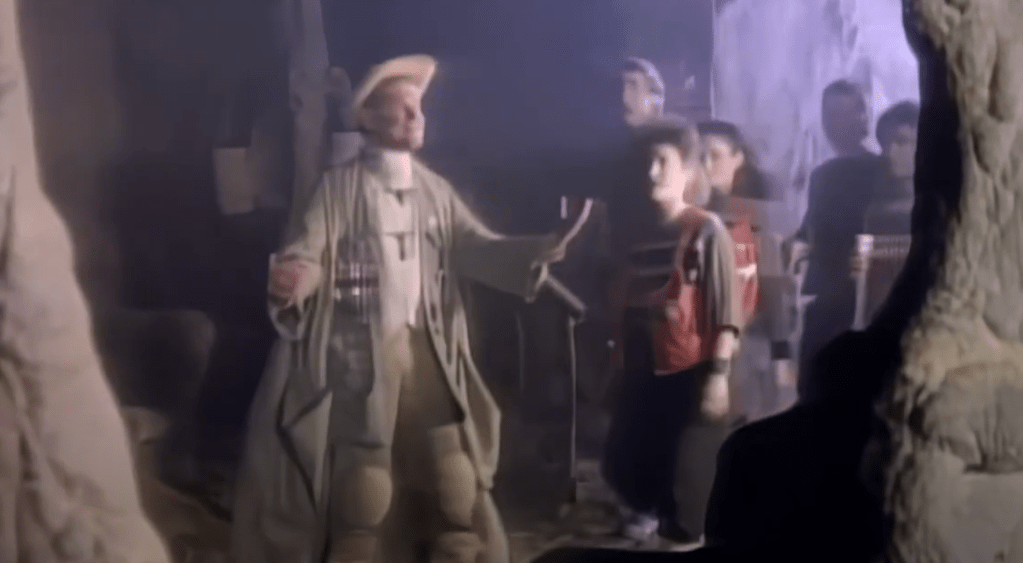
Pytka’s “Archaeology” is a commercial advertising Pepsi Cola. It opens in a futuristic mega-city (Scott’s BLADE RUNNER meets EMPIRE STRIKE BACK’S Cloud City) and a hover-ship with Pepsi markings flies over the opening (think A NEW HOPE’s opening), with inter-titles announcing: “EARTH – SOMETIME IN THE FUTURE”. We cut in on a mining company, a Pepsi vending machine (and importantly for the plot – you will find out why later) is prominently displayed. This establishing sequence has all the moody lighting and angles of Scott’s ALIEN (1979) or BLADE RUNNER (1982) and Lyne’s FLASHDANCE (1983). And “Archaeology” feels like we are almost seeing a trailer of the next big 1980’s summer sci-fi film. A teacher with his high school aged class moves into frame, giving a tour of this area. It is revealed as an archaeological dig of (presumably) a late 20th century suburban home. The teacher’s could charitably be described as sort of Indiana Jones meets Sting – in both dress and demeanor.
The students comb through the dig site – the “split level ranch house” as the Professor calls it – picking up random objects and asking the Professor to identify them (I guess handling and respect of archaeological materials changes significantly in future centuries). The first item the kids ask the Professor to identify is a baseball. The second item is an electric guitar. A third item is offered: some kind of cylinder caked in dirt. The professor is initially stumped. In a dramatic moment (that is even more dramatic if you watch the 60 second version of the commercial as opposed to the 30 second version), the professor uses a machine to clean all of the dirt off of the object, as his class, rapturously sucking down cans of Pepsi (or what we would derisively call liquid candy bars in today’s REAL future), eventually revealing a bottle of… Coca-Cola!
A student prods the professor, as others have for the guitar and the baseball – all seemingly stumped by the object, “WHAT is it??” We wait as the professor finally answers, “I have no idea”. The Pepsi hovership then dramatically flies over the professor, operating as a cut to the ship flying through the city again – and announcer and an end card that both announce, “PEPSI, The choice of a new generation.”
The entire piece is sort of a “one joke” commercial – but it is a heck of a joke. The production feels expensive – and the spot was not aired on the Super Bowl (at the time a landing place for big budget, high concept, ostentatious TV commercials – as it basically still is now), but the spot certainly could have been. The lighting, angles, and mise-en-scene again all add up to that 80s science fiction archetype. And although it was done better and previously in other films, I am not sure it is distilled as quickly, briskly and aptly as it is in Joe Pytka’s “Archaeology” commercial – and possibly as prevelantly to a mass child audience.
This was everything that was everything about 80s sci-fi in just 60 seconds – a vision board of 80s styles and influences that was omnipresent on TVs until the late 1980s. On a personal note, my sister and I used to freely quote this commercial to each other, like we would a favorite film, saying “I have no idea” when asked to identify regular every day objects in the kitchen or the store. And I would argue that Pytka and Pepsi’s “Archaeology” became just as ingrained in the minds of 80’s kids as ET, STAR WARS or THE GOONIES. So while other works that formed this style may have come before it, “Archaeology” may have distilled it the best, in one of the most memorable ways, and most importantly in one of the most accessible venues.
The commercial was a massive success for both Pepsi and Pytka. The “Archaeology” commercial received the Best TV Commercial award at the 26th annual International Broadcasting Awards and a Clio award in 1986 for U.S. Television/Beverages (non-alcoholic). Needless to say, the commercial ran everywhere at all hours for years.
In SKELETON CREW, the moody lighting, the mix of practical and enhanced, and semi-operatic style of “Archaeology” – now digitally enhanced instead of done through classic matte paintings, bulb wattage and smoke machines – takes visual precedence. Sure, you could say this style was already employed in ALIEN and BLADE RUNNER – but not many kids had seen those films. And that was really the attraction of seeing commercials like Pytka’s “Archaeology”. Kids were seeing dramatic techniques normally reserved for “artsy” adult fare now used in something that we as kids were watching regularly and devouring as OUR art. Those techniques seeped into our brains and in some ways made us value and appreciate the more sophisticated fare later – even though “Archaeology” was our induction point.
One other important side note is that both the “Messy Marvin” and “Archaeology” series have scores that are very important in establishing the tone of the commercial. Both help to create a fluidity of visual language that is not unlike Michael Giacchino’s own score for SKELETON CREW that is repurposed in both a rousing aggressive version as well as a more playful version – depending on the total ending of the show. Although not necessarily a direct influence, the use of score in Pytka’s commercials at least highlights the importance of its presence in SKELETON CREW.
IN CONCLUSION
After “Archaeology” and all of its success, Pytka would go on to direct commercials and music videos featuring the likes of Michael Jackson, Madonna, and eventually Michael Jordan (the “Hare Jordan” series for Nike that would later lead to SPACE JAM). Pytka also directed the underrated, underseen, though also less influential comedy LET IT RIDE, that is worth a watch and consideration if you are a big Joe Pytka fan, or maybe just want to know more about him.
His innovative approach to cinematography and editing and commercial direction continued into the later 1980’s, as a new style for Pytka began to emerge. This shift had been praised by Stanley Kubrick as creating a new style of cinema. Kubrick was a particular fan of Pytka and Lawrence Bridges – and specifically their series of Michelob and Lee Jeans commercials seen below:
Although I like the Michelob and Lee Jeans commercials above – and they are very important works in Pytka’s career – they were also from later in Pytka’s career in the late 80s/ early 90s and seemingly were indicative of his transitioning to another visual style, and that of the genre, into something that would set the precedence and influence later commercial directors like Michael Bay and Simon West and the cinema of the 1990’s. Pytka’s was an admirable and successful shift, though a style far less influential to SKELETON CREW and the thesis of the essay.
Instead it is Pytka’s commercial work in the late 1970s and early 1980s, and specifically the “Messy Marvin” series and the “Archaeology” commercial, that established a crucial framework and entry point for children to observe and understand a more mature visual palette and science fiction overall. And that influence works like SKELETON CREW to this day. Kids across the US who were tuning in to watch Saturday morning cartoons and were ready to watch animated cereal commercials and droll 1970s Madison Avenue commercials, were instead able to understand and observe a more mature visual palette and science fiction due to Pytka’s commercial work during this period, which provided a crucial foundation and starting point.
 No Scoops Club