On The Perils of Self-Sabotage, Perception, Idolatry, Rehabilitation, and Devotion
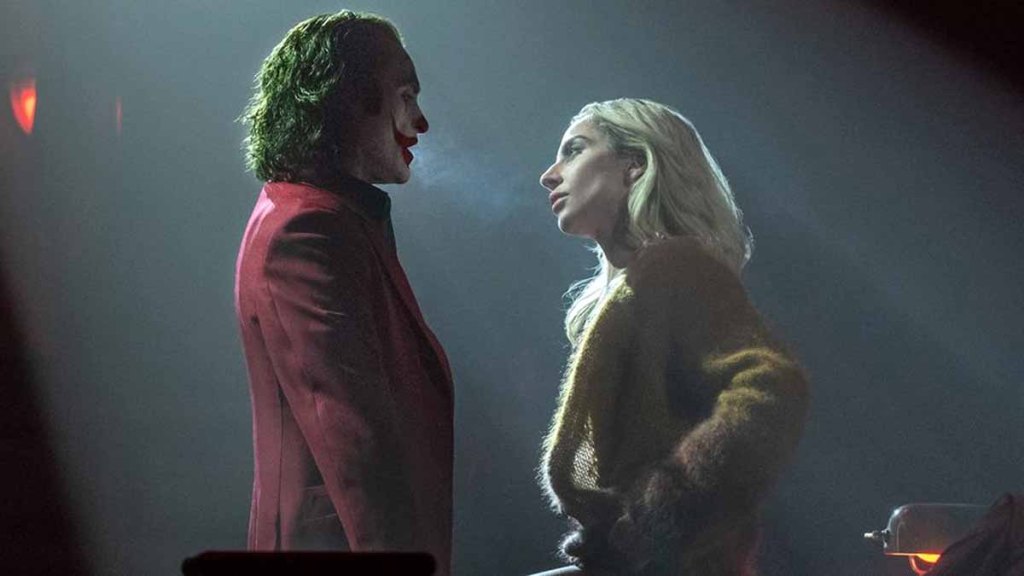
“When I decide to do something, I stick with it, total commitment.”
Joaquin Phoenix
As I first left director Todd Phillips’ masterful if purposely contradictory and confounding JOKER: FOLIE À DEUX (aka JOKER 2), I was left pondering, “what is the message of this film?” Unlike Phoenix’s quote above, his character Arthur Fleck aka Joker, could not ultimately commit to his alternate persona by the film’s end. Was this a damning decision, a responsible decision, a redeeming decision, or just the ultimate revenge on fans who may have mis-interpreted the sequel’s preceding film 2019’s Oscar-winner and billion dollar earning JOKER? As the thinking continued, I began to accept that perhaps the lack of a discernible message IS the message, that life and the choices we make, and especially the life and choices of someone as complicated as Arthur Fleck, are more complicated than a simple if/then formula, that we must push past that and the narratives in our heads or be doomed to destroy ourselves.
Some have asked, “Did Todd Phillips make JOKER 2 as revenge upon those who liked JOKER (albeit for the wrong reasons)?” But I think that intent went went further. I wondered, “Did Todd Phillips want JOKER 2 to fail?” In a sense, the film’s failure – both in terms of box office and critical reception – becoming a purposeful mirroring of Arthur Fleck’s own quest to reclaim the throne of the Joker – only to fail miserably. Did Phillips rid the world of his Joker once and for all (almost certainly) and did he great a smart piece of art to further that goal (debatable). Moreover, what would be the POINT of failure? And how could Phillips ensure that?
Let me first start by saying there will be spoilers throughout this essay. And that on the one hand these nihilistic readings can be productive. But they can also be reductive, offering cursory analysis and “an easy out”, even dooming the film to being categorized as simplistic or dismissible. But the film is not poorly made and is made with a very purposeful intent by a purposeful filmmaker. Todd Phillips, whether you like his films or not, is both successful and skilled at telling stories. With films like ROAD TRIP, OLD SCHOOL, THE HANGOVER TRIOLGY – Todd created characters and worlds that audiences remember, imitate and celebrate to this day. Perhaps he also unintentionally created just such a character with Arthur Fleck in JOKER, something he did not intend consciously, those his filmmaker skills betrayed him into creating a cool and calculated character, a representative of a disenfranchised and lost America that finally gets his revenge, and more importantly, his forum, his voice. That the film was intended as more a cautionary tale than a celebration was lost on many.
So with JOKER 2, Phillips and screenwriter Scott Silver (8 MILE) create a film that has to work to requalify and reposition that character. To do so, they first set up a narrative that has the propulsive momentum of a DC one-off graphic novel. Although this story per se would inherently not work in that format, it does as a cinematic equivalent (mostly because both musical numbers and courtroom numbers on screen can be used as substitutes for the usual “action and explosions”). Ultimately the characters all feel like they are on course to hit a brick wall at the end of a dead-end. And they do. Phillips leaves no room for any sequels. But there is a strength to the finality of story – like so many great one-off graphic novel tales be it EGO, NOEL, or THE KILLING JOKE there is a strength in finality that harkens to themes. And JOKER 2 has that same strength.
JOKER 2 begins where JOKER left off. Or does it? In fact JOKER 2 begins with Arthur Fleck’s trial on the verge of beginning in downtown Gotham. When JOKER ended, it felt like Fleck’s trial had concluded and that he had been effectively incarcerated in a mental institution for those crimes. So JOKER 2 begins by already arguably re-writing JOKER. Add that it has been over five years since JOKER was filmed and we already have an older and more worn Arthur Fleck. It is hard to imagine this version even being thought of as a child or a son – as he is so often discussed in the film. As the film progresses, so does the trial as well as Arthur travels from Arkham to the city. The two poles are poised as representatives of his mental state: Arkham being the haven for Arthur and Gotham as that of the Joker. As the film progresses the lines begin to get blurred, a process that is catalyzed by a fleeting but intense romance with Lee Quinn, a hanger-on played by Lady Gaga who also acts as Arthur’s prime enabler.
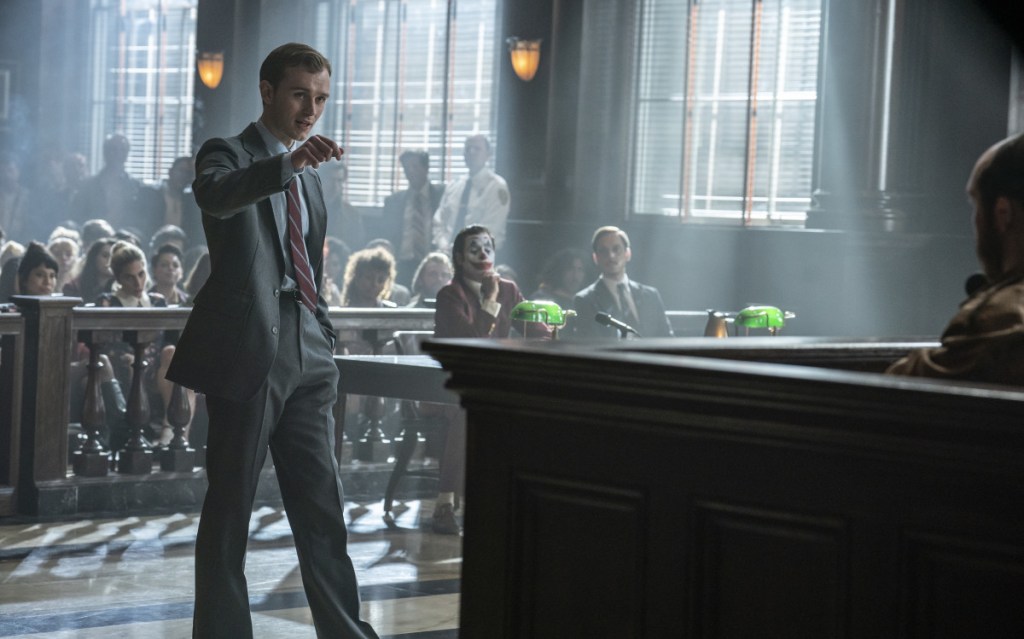
Arthur ultimately takes the mantle of Joker again when he decides to represent himself at trial but almost immediately regrets it when he is both beaten and abused and inadvertently causes the death of one of his fans/followers at Arkham. He repents in front of the jury who answer by condemning him and judging him guilty – which is almost a relief for Arthur. But there is no time for that yet as a car bomb explodes outside the courthouse which allows Arthur to briefly escape and reunite with Lee. Unfortunately she had walked out earlier when Arthur decided to repent and admit to his crimes and tells him that their relationship was always a fantasy predicated on his being Joker – not Arthur. Arthur is captured, taken back into custody, and ultimately murdered by a copycat Joker in Arkham (who will no presumably take on the mantle).
So what are this film’s themes? And can a film that appears at least aimed for failure even carry successful themes? I would argue that it has to. Regardless, the nature of the provocation that “no message IS the message”, or that :it was supposed to fail” still necessitate Todd Phillips and screenwriter Scott Silver to set themes up – if only to knock them down or exhort them – in order to further their goals of finality and failure.
As it stands, I think Phillips and Silver explore a number of themes worthy of a deeper scrutiny, including idolatry, perception, rehabilitation, devotion, and ultimately self-sabotage. Whether or not they are meant to stand or to be representative of some greater statement is the subject of this essay.
IDOLATRY
I stand here waiting for you to bang the gong
APPLAUSE/ Lady Gaga
To crash the critic saying, “Is it right or is it wrong?”
If only fame had an I.V, baby could I bear?
Being away from you, I found the vein, put it in here
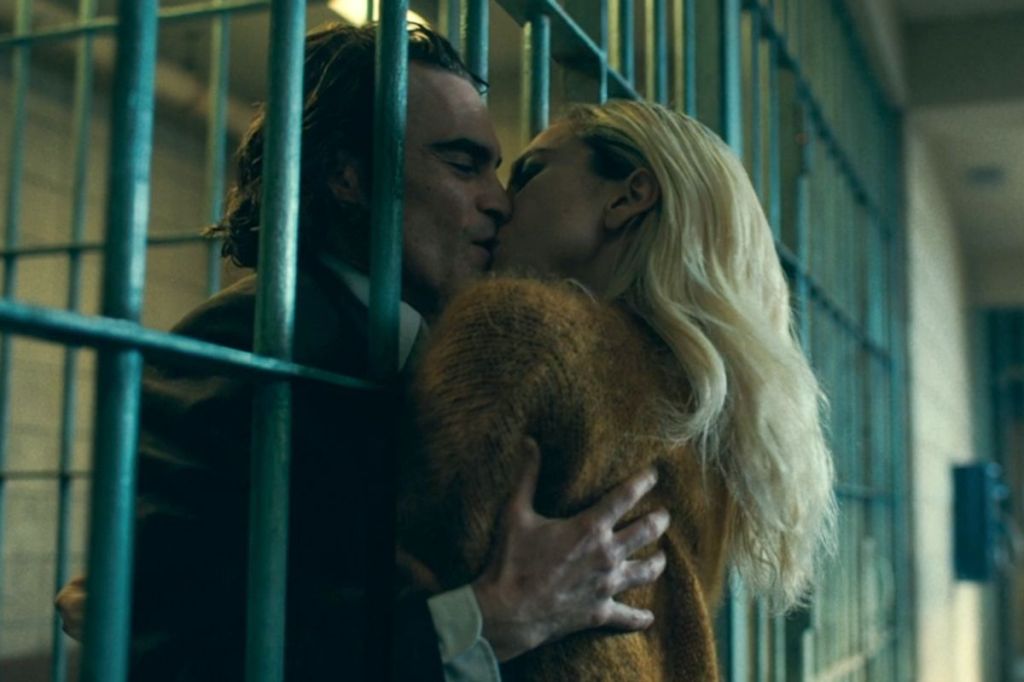
As the film begins, Fleck is incarcerated, waiting for trial but known by the people of Gotham as “Joker”, a folk hero that has become a mouthpiece and unwitting icon for the poor, the unheard, the abused, the discontented, the lonely. But those who “knew him when”, that is, before he became the Joker so publicly when he assassinated Murray Franklin, are less enthralled. To them he is a pathetic madman. Be it co-worker Gary Puddels or neighbor Sophie. They have nothing but fear and pity for Arthur, no worship necessary. And yet, enter Lee Quinn, an inmate in the minimum security ward at Arkham, who is in a choir (???) class. She has a chance encounter with Arthur which begins his recidivistic slide (more on that later).
If Joker is a deity in Gotham, then Quinn becomes his primary subject, a representative of the masses that stand outside the courthouse with shirts and posters each day to welcome Arthur to his trial. But she also becomes his primary instigator, provocateur and exhorter. She pushes and needles at Arthur, using pride and vanity to make him question his post-murder spree path. It is a curious buy-in, and maybe the most trepidatious from the perspective of the viewer: would a damaged Arthur Fleck in rehab be so willing to be into this clingy, devoted woman?
Sure, maybe his Joker persona might, but perhaps that is who Quinn is playing towards. The phrase directly translates to madness for two. The term means (from the Merriam Webster dictionary): the presence of the same or similar delusional ideas in two persons closely associated with one another. Yes Arthur has his issues. But so does Lee. And two wrongs do not make a wrong. They just make more wrongs. In this case, Lee wants a god and Arthur wants to be a god. In the end Arthur renounces his quest and that ultimately breaks the madness as a normal, flawed, pathetic Arthur is not worthy of worship – or lies.
You see, over the course of the film, we discover that Quinn lies repeatedly to Arthur about the nature of her past and their relationship throughout the film. She leaves a trail of purposefully manipulative lies: that she grew up in Arthur’s neighborhood, that her father died in a car accident, that she set her apartment on fire, that she would like to kill her mother, and ultimately that she is pregnant with Arthur’s baby.
All are revealed to be falsehoods at one point (although one about whether or not she watched the TV movie based on Arthur over 20 times is revealed to be a white lie as she watched it “maybe only 4 or 5 times” – a reveal that made me laugh and felt like something Harley Quinn might say in the pages of a DC comic). But Lee is a window to the myth, a myth that will ultimately crumble to be reborn stronger. Quinn is talking to the Joker, searching for him inside of Arthur.
There is a good portion of JOKER 2, that asks the question both explicitly (in the trial) and implicit, whether or not Arthur and Joker are the same person – and a good deal of the conclusion seems to also want to address this. It ties into rehabilitation even though it is also a question that is applicable to all superheroes and villains that seemingly dawn a costume and a mask. Something just below the surface but which would never ever be found in an MCU film (maybe that’s a good thing for box office but a poor choice for intelligent examinations). In the end the same people that are cheering outside the courthouse are stand-ins for those of us who might show up on the opening night of an MCU film, or for a sports team, or a political candidate. Ultimately, idolatry is tantamount to toxicity – a lesson that if not clear in JOKER is certainly clear in JOKER 2.
Speaking of the original film, the Joker has become a myth, both in our world and in the universe of the film, a belief held by the masses as represented by the courthouse crowd and initially Lee. They, like the audience watching the film, have all been influenced by the media and that which it produces: a “TV movie” inside the film and the actual JOKER film in our world. In a way, and this will not be the first meta statement embedded in the film, this is a meta commentary on both the original JOKER film as well as superhero films of the whole – our expectations of them and of what they have become. Joker and his proverbial sequel must live up to those expectations and they both have trouble doing so. Is this purposeful and intentional or just a coincidence?
PERCEPTION
Sometimes everything is wrong
EVERYBODY HURTS/ REM
Now it’s time to sing along
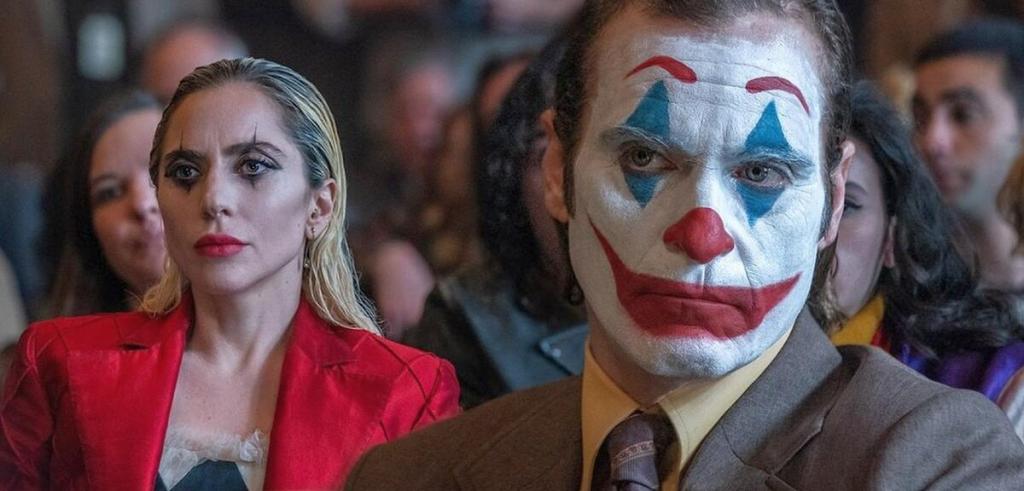
One of the most talked about parts of Phillips and Silver’s film, at least initially, was that it would be featuring musical numbers. The musical aspect of the film is mostly set within Fleck’s mind and occasionally, presumably, that of his admirer/beau Harleen Quinzel, aka Harley Quinn, aka “Lee Quinn” (played by actress and singer Lady Gaga) in the world of this film. The musical numbers work as a way to demonstrate how Arthur romanticizes his dreary life, an aspect that was part of the final reveal of the original JOKER film with his relationship with neighbor Sophie (briefly seen in the film while giving testimony in Arthur Fleck’s trial).
Again, Arthur’s Joker “persona” is occasionally revealed for the first two acts only in the eyes of the beholder (Arthur and Lee) and in musical numbers that let the audience in behind those eyes. But they also work as a metaphor for the ways in which we, in our everyday lives, buy into fantasies and lies as a coping mechanism. This is a process which can draw one away from even the most ardent and well-meaning rehabilitation. Are these flights of fantasy a regression or a reinforcement of our rehabilitation? It is hard for Arthur to tell initially, as it is in our own lives. And yet the musical pieces show the audience how and why Arthur buys into Harley’s lies despite not entirely knowing what ends they serve.
Because they serve his own desire for a “happy ending”. But what is the cost of a “happy ending” with Lee? Like someone once said in an Avengers film back in the day: “Everything”. The road to that ending would take him entirely away from his current path – a path to becoming Joker again – a path away from one of rehabilitation, of atonement, and a possibility of real change.
REHABILITATION
The man said “Why do you think you here?”
REHAB/ Amy Winehouse
I said, “I got no idea”
I’m gonna, I’m gonna lose my baby
So I always keep a bottle near
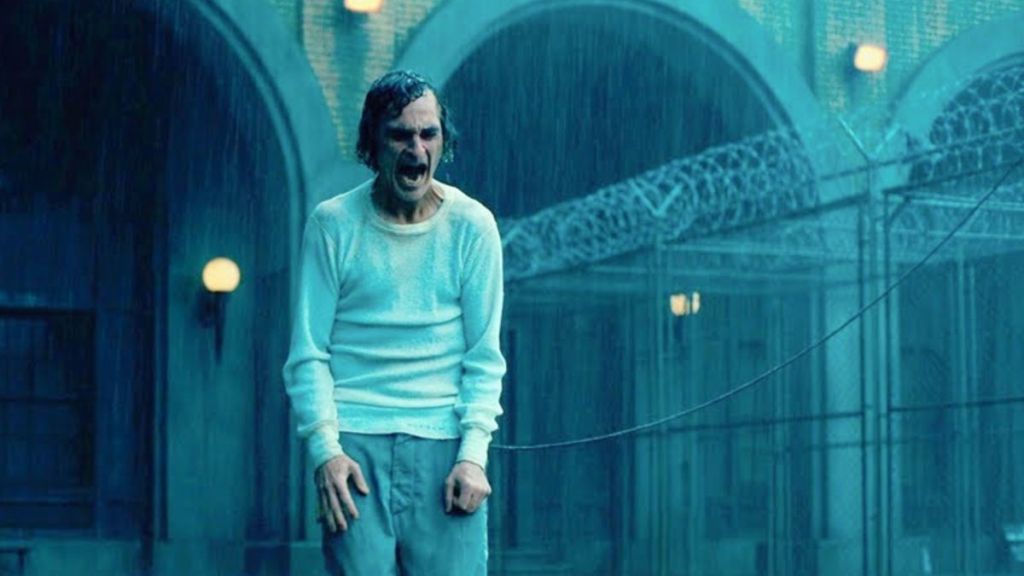
One of the more interesting parts of JOKER 2 is the first act’s reveal of a reformed Arthur Fleck. Fleck has become a model prisoner. He is friends with guards, they give him cigarettes as he entertains them. It is a humiliating existence, a humiliation that he is not entirely unaware of. But he plays to it, takes his medication, has a lawyer (played by a muted but focused Catherine Keener) that appears to be intelligent and working in his best interests, and is even given choir privileges at the suggestion of a guard after he sees a chance encounter between Lee Queen and Arthur outside of the class.
It is not a great existence but it is an existence. He could last another 40 years in this incarcerated world. But does he really want to? Once Lee enters the picture, you begin to think that at least part of him – the “Joker” part of him – does not. He wants to get off this past but needs to find an exit ramp as much as Lee Quinn wants to find the highway. And when they meet they are a perfect model of codependency, at least for a while, and a great look at the toxicity that results from such relationships. Lee gets her fame, her idol in Joker – and Arthur/Joker gets a path to leave the world of the rehabilitated and the mundanity and humiliation that might be de rigueur over the next 40 years of his life.
But that path requires commitment and devotion, not just by Lee or by Arthur’s sycophantic fans – but by Arthur himself. Is he willing to go the distance? Does he have what it takes to stay committed and devoted to being Joker?
DEVOTION
Oh baby
LET’S STAY TOGETHER/ Al Green
Let’s, let’s stay together (‘gether)
Lovin’ you whether, whether
Times are good or bad, happy or sad
There is a great monologue in David Ayer’s 2016 SUICIDE SQUAD (I know – hear me out) by non other than Harley Quinn – this time portrayed by Margot Robbie. Harley has always been a character that embraces her villainy and by doing that, makes it almost heroic. In this scene, she is serving a drink to El Diablo aka Chato Santana, who is having regrets about his life choices and the man with whom he has become.
In fact, Harley realizes, before the other members of the Squad and most of the audience, that Santana killed his family. Diablo is remorseful and regretful. But Harley is not judgmental, instead she tells him, “Own that shit. Own it. What did you think was gonna happen? That you can have a happy family and coach Little League and make car payments? Normal is a setting on the dryer. People like us don’t get normal.” A psychopathic reaction for sure but also one that is devoted and committed, as many successful villains are.
Arthur seemingly decides that he wants to be a successful villain again. And he reclaims his Joker persona in the third act, dawning his Joker “suit” and make-up for a riveting cross-examination of dwarf Gary Puddels, one of the witnesses to one of his killings in JOKER. It is a riveting scene that ends in Joker nearly becoming Arthur again. But in this scene, all can see Arthur firmly off the path of rehabilitation. But going astray leads to a question of commitment, of devotion. Can Arthur/Joker maintain this act beyond this little love affair with Harley and his courtroom trial?
This devotion is put to the test after Arthur/Joker badmouths the same prison guards that were kind to him during his rehabilitation. When he returns to Arkham he is beaten, defiled, and humiliated – an event that might set “the real Joker” (or rather who the audience thinks is “the real Joker”) further onto a path of violence. But not Arthur, he loses his humanity and it breaks him. As Heath Ledger once said in THE DARK KNIGHT, “Whatever kills me makes me STRANGER.” That is not the case for Arthur and fundamental to his reluctance to become JOKER and to live and embrace that role.
In fact, that event breaks Arthur to the point that, in court on the following day, he appears without makeup and admits that he was always Arthur – he was never Joker. He always knew what he was doing and was fully competent in all of his killings – as Arthur. Harley walks out of the courtroom and does not return his calls. But the wheels of the Joker have already been set in motion far past Arthur’s decision to abandon the persona. In fact, a car bomb has already been set up which blows a hole in the court room, killing and injuring many people (including noticeably Harvey Dent). The bomb then leads to a car chase and a foot chase which leads to a climax on the top of the infamous “Joker steps”. Here Arthur meets Harley, finally catching up after she walked out in the courtroom earlier after Arthur admitted that there was no Joker. Harley tells him that their relationship was always a fantasy (a fantasy predicated on Arthur being Joker), and it was a fantasy which he broke when he admitted to his crimes in the courtroom earlier, when he admitted he was Arthur and not Joker. She walks away, slipping through his fingers. It is a hard lesson for Arthur, and maybe his final one: devotion is essential in idolatry, in myth-making – and by association in comic books and the movies that come from them.
If you break character, there will not be thoughtful pleasantries and courtesies – but rather more humiliation. Is this result a damning statement for the disenfranchised (especially when looking at who Arthur was and who people see him as) and their options in this world – that if you appeal to your humanity as opposed to your inhumanity, you will be punished? Yes – but in Phillips’ world it may be a noble, transgressive (more on that in the conclusion) one. Also in Phillips’ world, once you put that make-up on, you best not take it off.
If you are going to be the Joker, you better BE THE JOKER and stick to it. In the end, Arthur never was the Joker, just a nervous, deluded man, the butt of all jokes, and he owns it – whether he wants to or not. It is a brutal ending. But is it an intentional one?
SELF-SABOTAGE
I started a joke which started the whole world crying
I STARTED A JOKE/The Bee Gees
But I didn’t see that the joke was on me.
There is a meta quality to this last theme that is a direct result of the previous theme of devotion, or lake thereof. You see, the end of the Joker involves the broken Arthur returning to Arkham after the car bomb, and the escape, and the dismissal from Harvey. He is presumably waiting for his sentencing, passing the hours away watching TV, a pathetic and humbling existence. He is told that he has a visitor and is escorted to the visiting area, but he never gets there. On the way he is confronted by a younger inmate that has been quietly shadowing him, presumably enthralled, throughout the film. The inmate tells him a joke and kills him, laughing maniacally as Arthur lies bleeding out and dying on the floor.
Presumably this inmate is either a.) the man who will become the “real Joker” – the one that will go on to fight Batman and the now transformed Harvey Dent and Harley Quinn or b.) the metaphorical reincarnation of Joker. The idea that you cannot kill Joker because ultimately it is bigger than one man but rather an idea (a theory also advanced less ably in JOKER). But he could also be both.
And this inmate could also be something else, a device of Arthur/Joker’s own making to deliver him from his own existence. A method of self-sabotage to get him out of this hellhole and yet also have his ideas live on. From a meta standpoint, the same can be said of this film. Perhaps Todd Phillips no longer wanted to be associated with Joker as a property and yet a sequel nagged at him both internally and externally. He was able to scratch the itch and direct the film (like Arthur putting the costume and make-up back on for the courtroom scene) and yet also bury the franchise.
Maybe Arthur wanted to die all along – but wanted to have control over how it was done. And maybe Phillips wanted to have a sequel to JOKER all along but also ensure no further sequels would ever be made. Both were successful. I don’t think Todd Phillips was “forced” to make the film. I don’t think Arthur hated the Joker. But I do think both filmmaker and the character he wrote were tortured by the choice. It is much more complicated in that I both have very mixed feelings about their ultimate decisions. Though Todd directed JOKER 2 and Arthur ultimately becomes Joker again, they both have essentially self-sabotaged their positions to the point that they will never have to deal with that choice again. The Joker at the end is both an in-universe and a meta commentary about Gotham and the genre, respectively, living on without Joaquin’s Joker, but still having a Joker – for better or worse.
SO DID TODD PHILLIPS ACTUALLY WANT THIS FILM TO FAIL?
Probably. Todd Phillips debut film was a documentary on GG Allin, HATED: THE GG ALLIN STORY. Allin was a transgressive punk rock musician and the nature of punk rock is defiance and the nature of transgression is to offend. Did Phillips position JOKER 2 to primarily offend and defy? It seems that is likely the case.
Similarly, Allin took extreme means in adhering to the core values of punk often berating fans and even defecating on stage. A transgressive artist’s goal is to offend and to outrage. Did Todd take a page from Allin’s book, creating a film that would essentially offend and outrage – even the so called fans of the first film? I think he did. Allin once said, “It’s like I’ve got this wild soul that just wants to get out of this life. It’s too confined in this life. I think that to take yourself out at your peak… if you could die at your peak, your strongest point, then your soul will be that much stronger in the next existence.” Perhaps both Arthur Fleck – and to a greater extent Todd Phillips with his handing of the JOKER property – both took this quote to heart.
In conclusion, JOKER 2 is a complex and challenging film that explores themes of myth, perception, rehabilitation, devotion, and self-sabotage. Through the character of Arthur Fleck aka Joker, the film examines the ways in which we create and maintain our own realities, often at the expense of our true selves. It also questions the nature of heroism and villainy, and the role that society plays in creating and perpetuating these roles. Ultimately, JOKER 2 is a cautionary tale about the dangers of self-delusion and the importance of accepting our true selves, even when it is painful – we must stay committed.
What did you think of JOKER 2? Am I way off? Is this interesting, inspiring, or delusional – or maybe all of the above? Let me know in the comments below and if you liked this essay, please consider giving it a like.
 No Scoops Club
dude, aside from a few spelling and orthographic mistakes, you’re spot on. Even before reading this essay (I just finished watching the movie) I thought to myself “Todd Phillips absolutely does not want to make another Joker film. The best way to do that is to give the middle finger to everyone who had an interest in a continuing cinematic universe, including the film’s investors,” which is the cherry on top of this two-layered cake. Pure and simple, Arthur does not commit. He gets committed. Either to an institution, or consigned to the collective ideological might of those who saw a messiah in the Joker. Todd surely felt external pressure to make a sequel from a force analogous to the ideological one in the film: a socioeconomic force in our world. Sure, I think he was probably fine revisiting his Joker even though it certainly was not meant to have a sequel, but he would only do it provided that he gets a message across to the audience. To me, that message is “careful what you wish for.” Everyone chomping at the bit for a sequel was made to regret their fanaticism. The investors who wanted to rake in another few hundred million dollars also experienced the roundest “no” that they have heard in their lives, spoken in tandem with the voices of the audience. I think that’s just amazing. It’s art, it’s social engineering, it’s rejection of clout, it’s ragebait, but above all, it is clearly intentional.
LikeLike